All products / Usage / Recovery & Repair
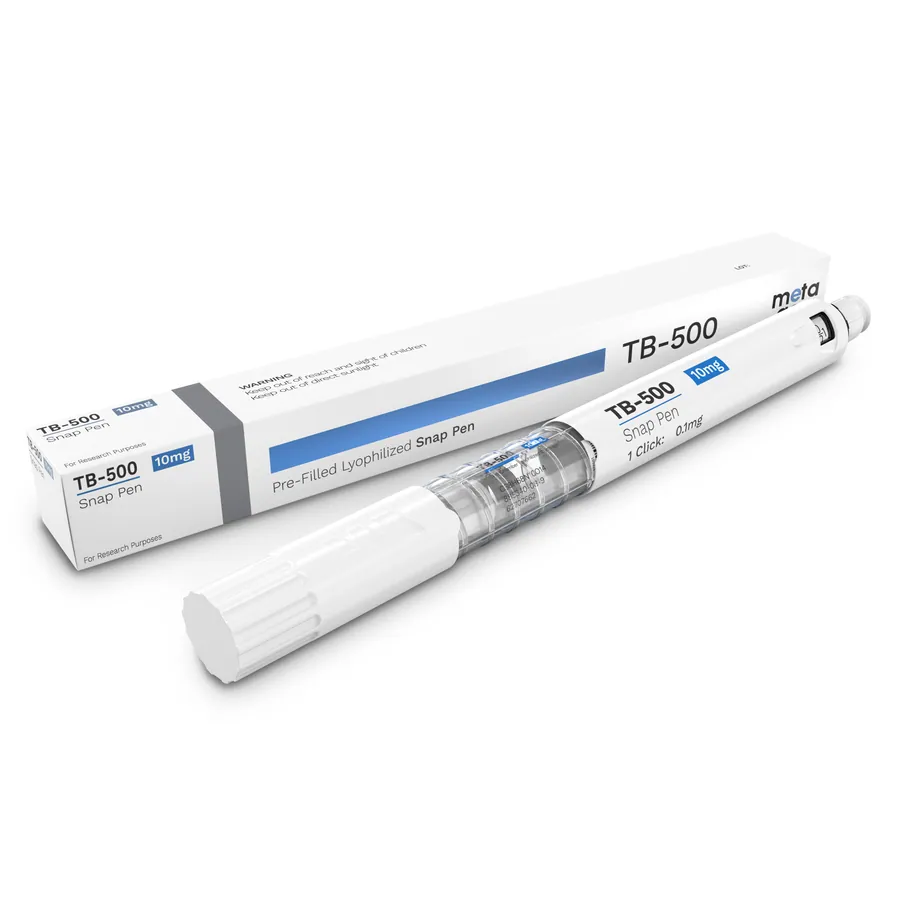
TB-500 10mg Snap Pen
Tissue-repair, flexibility & cellular-regeneration research
SKU: SP-TB-10-1
 99.5% Purity
$145
- Format
- Snap Pen
- Dosage
- 0.05mg per click
- Capacity
- 10 mg
Potential benefits
- Wound-repair research
- Cell migration & tissue-repair research
- Flexibility & fibrosis research
- Angiogenesis & blood-flow research
- Anti-inflammatory action
- Muscle-regeneration research
- Organ & vascular regeneration research
TB 500 is a synthetic fragment of thymosin beta‑4, a naturally occurring peptide vital for cell movement, tissue repair, and new blood vessel formation. Engineered for improved stability and delivery, TB 500 research investigates tissue-repair signalling across muscle, tendon, ligament, skin, and internal organs in preclinical models. Studied in models of injury recovery, inflammation modulation, and functional mobility.
Designed for research of active individuals and those in recovery, TB 500 works systemically traveling through the bloodstream to reach damaged areas. This makes it ideal for those dealing with sports injuries, post-surgical healing, chronic joint pain, or tissue damage. Its angiogenic and anti-fibrotic activity is also studied in heart, eye, and neurological repair models.
TB 500 purportedly targets several key processes to support systemic healing:
Actin Regulation & Cell Migration: Binds G‑actin to regulate cytoskeletal dynamics, facilitating cell movement into injured tissues.
Angiogenesis: Stimulates endothelial cell migration and capillary formation to improve circulation and nutrient flow.
Anti-Inflammatory Pathways: Modulates immune response, reduces neutrophil activity, cytokine release, and apoptosis, promoting a healing environment.
Tissue Remodeling & Fibrosis Reduction: Encourages collagen deposition while preventing excessive scarring for better elastic recovery.
Designed for research of active individuals and those in recovery, TB 500 works systemically traveling through the bloodstream to reach damaged areas. This makes it ideal for those dealing with sports injuries, post-surgical healing, chronic joint pain, or tissue damage. Its angiogenic and anti-fibrotic activity is also studied in heart, eye, and neurological repair models.
TB 500 purportedly targets several key processes to support systemic healing:
Actin Regulation & Cell Migration: Binds G‑actin to regulate cytoskeletal dynamics, facilitating cell movement into injured tissues.
Angiogenesis: Stimulates endothelial cell migration and capillary formation to improve circulation and nutrient flow.
Anti-Inflammatory Pathways: Modulates immune response, reduces neutrophil activity, cytokine release, and apoptosis, promoting a healing environment.
Tissue Remodeling & Fibrosis Reduction: Encourages collagen deposition while preventing excessive scarring for better elastic recovery.
- In rat models, TB 4/TB 500 increased wound re-epithelialization by up to 61% at day 7, with boosted collagen deposition and angiogenesis. Actin modulation is studied in cellular-repair pathways relevant to muscle, tendon, ligament, and skin tissue.
- Encourages tissue remodeling and elasticity by regulating F-actin and limiting scar tissue formation.
- Studied for endothelial cell migration and new blood-vessel formation, with preclinical interest in nutrient delivery and cardiac repair.
- Studied for modulation of pro-inflammatory cytokines and anti-inflammatory signalling in chronic-inflammation models.
- Investigated for muscle-repair signalling and maintenance of muscle quality following injury.
- Preclinical data supports benefits in heart, eye, and nerve recovery via enhanced endothelial and cardiac cell survival.
References
- Thymosin beta‑4 accelerates wound healing
- The regenerative peptide thymosin β4 accelerates the rate of dermal healing
- TB‑4 improves endothelial dysfunction and angiogenesis in diabetic hiPSC‑ECs
- Thymosin beta‑4 enhances the healing of medial collateral ligament
- Thymosin β4: a multi-functional regenerative peptide
- Beneficial effects of thymosin β4 on spinal cord injury
- Thymosin beta‑4 and corneal wound healing
| Molecular formula | C38H68N10O14 |
|---|---|
| Molecular weight | 4963 Da |
| CAS number | 885340-08-9 |
| Purity | 99.5% |
| Storage | Before reconstitution, store 6–50°C, refrigeration is not required. After reconstitution (mixing), keep refrigerated at 2–8°C at all times, use within 6 weeks. Do not freeze. Keep away from direct sunlight and heat. |
Sequence: Ac-Ser-Asp-Lys-Pro-Asp-Met-Ala-Glu-Ile-Glu-Lys-Phe-Asp-Lys-Ser-Lys-Leu-Lys-Lys-Thr-Glu-Thr-Gln-Glu-Lys-Asn-Pro-Leu-Pro-Ser-Lys-Glu-Thr-Ile-Glu-Gln-Glu-Lys-Gln-Ala-Gly-Glu-Ser
Synonyms: TB500, 885340-08-9, UNII-QHK6Z47GTG,, TB-500,, QHK6Z47GTG